Key points
- Most of our mills grind on a ceramic mechanism, which the product details describe as resisting corrosion.
- Whole peppercorns and coarse salt go in the mill, and fine table salt goes in a shaker.
- Battery mills take AAA or AA cells you replace, and the USB mill has a battery you charge.
- EPA says rechargeable batteries do not belong in the trash, and that applies to a mill with one built in.
Ceramic, steel and rasp mechanisms
Inside every mill, a fixed part and a turning part crush the grain between them. Most of our mills grind on ceramic. The product details for the Frosted Glass grinder and the USB grinder say the ceramic mechanism resists corrosion, and that is the reason it suits salt, which sits against the mechanism for months between refills. The Nottingham walnut mill, the 8-inch manual mill, the glass pair, the magnetic pair and both battery mills grind on ceramic too.
The One-Handed 2-in-1 works differently. It uses a rasp mechanism, with salt at one end and pepper at the other, so a single mill covers both. Steel mechanisms are the other common type in kitchens. If you own a mill with a steel mechanism, read its manual before you fill it with salt, since not every maker intends it for both.
What goes in a mill and what does not
A mill is built for whole, dry grains: peppercorns and coarse salt. Our USB rechargeable gravity grinder names both in its refill instructions. Fine table salt is already ground, so it flows straight through a mill or packs around the mechanism. Keep it in a shaker, a salt cellar or a salt pig instead.
Whole grains are also the ones that keep. Clemson's Home & Garden Information Center lists salt as keeping indefinitely and whole spices for years longer than ground ones, and Ohio State University Extension agrees that whole spices outlast ground. Grinding at the table means the pepper meets the air a second before it meets the food. The guide to how long spices last has the full set of figures.
- Whole black peppercorns: every mill in our range.
- Coarse sea salt: any ceramic mill, and the salt end of the 2-in-1.
- Fine table salt: a shaker or a cellar, not a mill.
- Damp or oily blends: a jar and a spoon, not a mill.
Grind settings
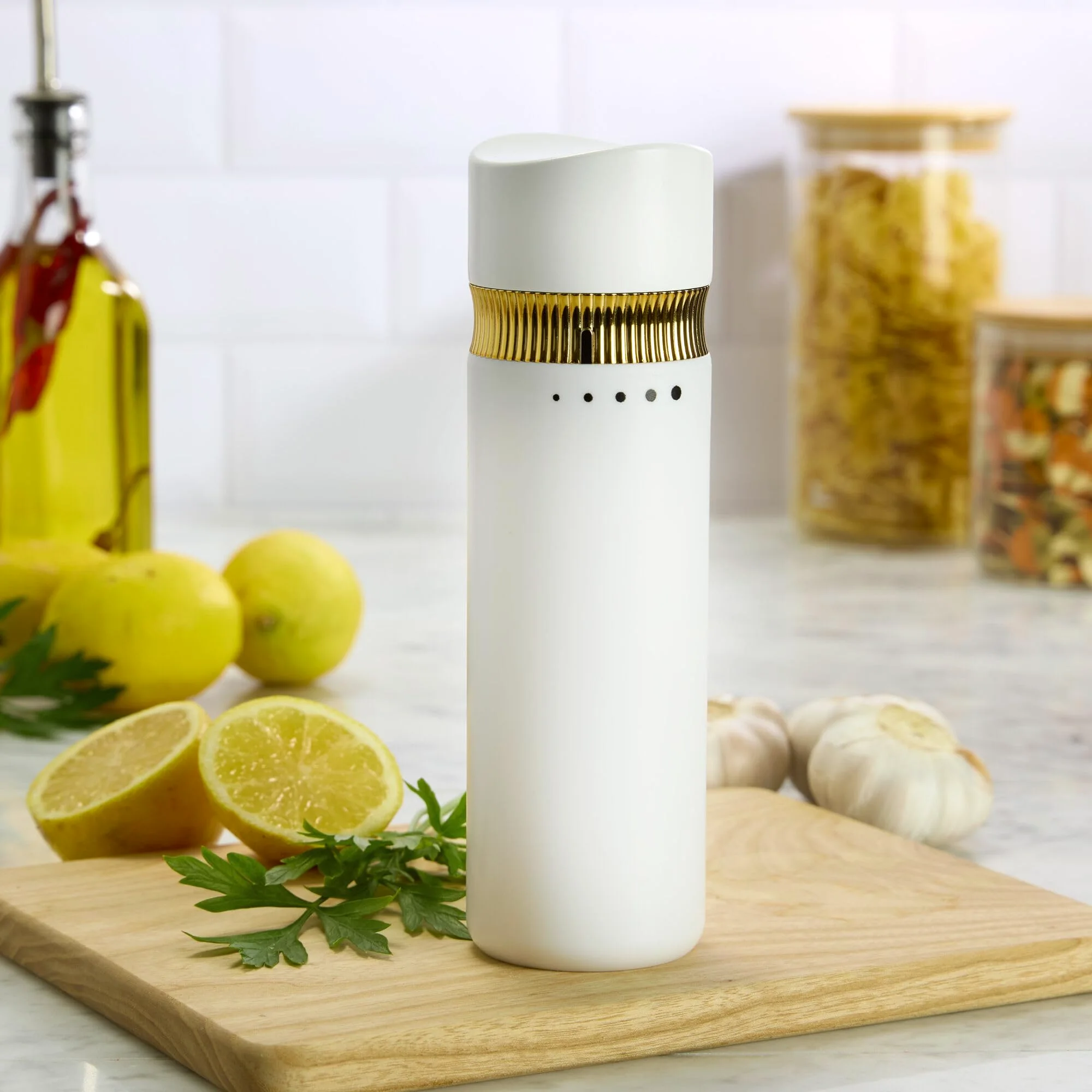
Turning a knob or dial moves the two parts of the mechanism closer together or further apart. Closer gives a fine powder for a sauce. Further gives cracked pepper for a steak. The 8-inch manual mill has five preset levels marked by a row of dots, from fine to coarse, and the USB grinder has a five-step dial. The glass pair, the magnetic pair, the Frosted Glass grinder and the Nottingham adjust from fine to coarse without fixed steps.
Set the grind once with the mill over a plate, not over the food. Turn it a few times, look at the grains, and adjust a step at a time. Once you have it, leave it there.
Manual, battery or rechargeable
A manual mill needs nothing but a turn of the wrist. It is the quiet choice for the table, and the Nottingham, at 4.5 inches in walnut, sits by a plate without looking like a kitchen tool. The trade-off comes at the stove, where twisting takes two hands and one of them is usually holding a spoon.
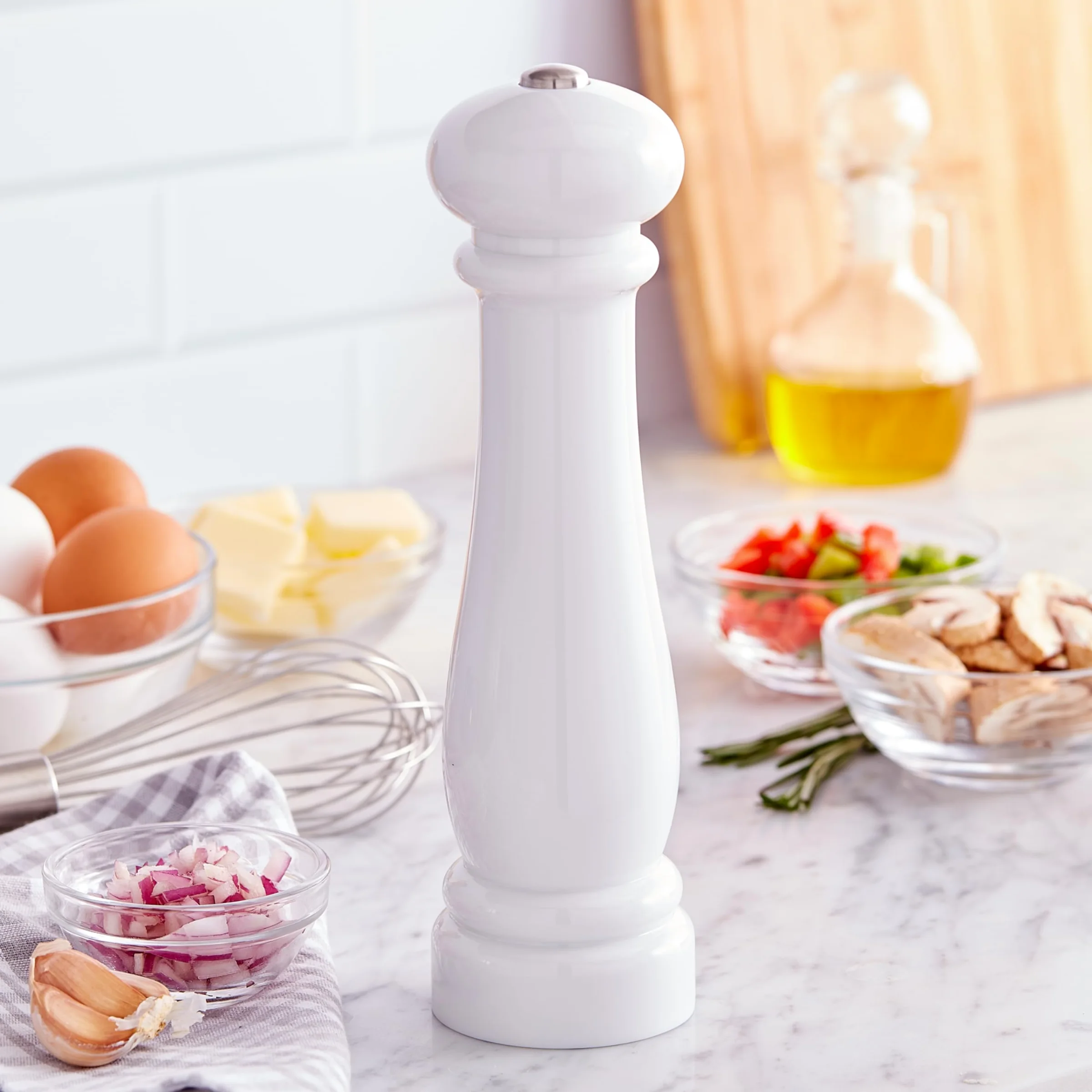
A battery mill grinds at the press of a button, one-handed. Our Traditional Glossy battery grinder stands 10 inches tall in black or white and takes 6 AAA batteries, not included. The Battery Grinder with Light is a slimmer 8 3/4 inches in stainless steel, takes 2 AA batteries, not included, and lights up when you press the button, so you can see how much pepper lands in the pan.
The USB gravity grinder has no batteries to buy. You turn it over and it grinds, with an LED that comes on when the opening points down, and you turn it right side up to stop. The product details give a 45-minute run time and a full charge in as little as 3 to 4 hours over the USB cable, with an indicator light that turns blue when it is full. Charge it on the counter away from the sink, where the cable stays dry.
| Mill | Power | Mechanism | Grind setting | Size |
|---|---|---|---|---|
| Traditional Glossy Battery | 6 AAA, not included | Ceramic | Not stated | 10 in tall |
| Battery Grinder with Light | 2 AA, not included | Ceramic | Not stated | 8 3/4 in tall |
| USB Rechargeable Gravity | Built-in battery, USB charging | Ceramic | 5-step dial | Prefilled with peppercorns |
| 8-Inch Manual, White and Gold | Hand | Ceramic | 5 preset levels | Holds 150 g peppercorns or 300 g salt |
| Nottingham Walnut | Hand | Ceramic | Fine to coarse | 4.5 in tall |
| One-Handed 2-in-1 | Hand | Rasp | Fine to coarse | 8 in, salt and pepper in one |
| Frosted Glass with Salt Shaker | Hand twist | Ceramic | Fine or coarse | Pepper mill below, salt shaker on top |
| Magnetic Pair | Hand | Ceramic | Coarse or fine | Two mills that attach |
How to fill each mill
Fill over a bowl or a sheet of paper, never over the pan. A wide funnel of folded paper gets peppercorns in without bouncing them across the counter. Each of our mills opens its own way, and the product details spell it out:
- 8-inch manual mill: pull the cap off, fill with salt or peppercorns, put the cap back and twist to grind.
- Nottingham: remove the top knob and the upper part of the mill, fill, and put both back before grinding.
- USB gravity grinder: remove the lower compartment, fill the reservoir with peppercorns or coarse salt, and snap it back on.
- Glass pair: unscrew the tops, fill the reservoirs and screw the tops back on. The glass shows when you are running low.
- Magnetic pair: unscrew the stainless steel top and add salt or peppercorns.
- Frosted Glass grinder: unscrew the silicone top, pull out the salt shaker, fill the bottom with peppercorns, then fill the top reservoir with salt.
- 1
Grind the old contents nearly empty before you refill, so old grains do not sit under new ones.
- 2
Wipe the outside with a damp cloth. The magnetic pair should not go under water, and the Battery Grinder with Light is wiped and towel-dried.
- 3
Keep a mill full of salt away from the steam of the pot, as with any spice jar.
When the batteries run out
The AAA and AA cells in our battery mills are the common single-use kind, and the U.S. Environmental Protection Agency explains on its used household batteries page what to do with them. In most communities, it says, alkaline batteries can go in household trash, but EPA recommends sending them to a battery recycler or asking your local or state solid waste authority. Battery types are known by their markings, not their shape, so read the label before you sort them.
Rechargeable batteries are a different matter. EPA says they should not go in the trash or in municipal recycling bins. When a rechargeable battery is built into a device and cannot be removed, EPA's advice is to take the whole device to a certified electronics recycler, a takeback program at a participating store, or a household hazardous waste collection. That covers a USB mill at the end of its life. EPA also notes that a used battery can hold enough energy to start a fire even when it seems dead, and for rechargeable and lithium batteries it suggests putting each one in its own plastic bag or taping over the terminals until you drop them off.
When you shop for a mill, think about that last step too. A manual mill has none of it. A battery mill asks for fresh cells now and then. A rechargeable one asks for a charger and, someday, a trip to a recycler. Every mill in the range sits on our salt and pepper shelf, and each card says how it is powered.
Every piece named here is part of the Kamenstein kitchen line.